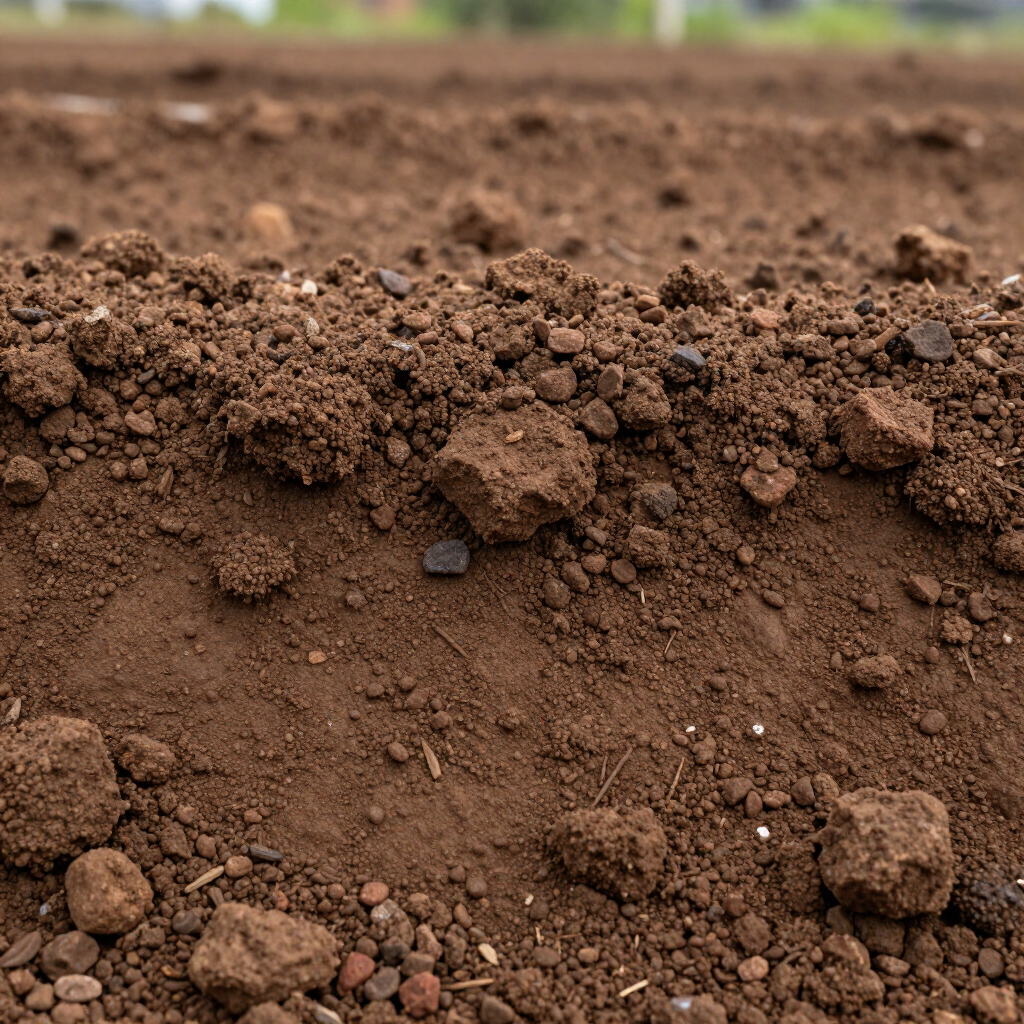
The Installation Compaction Paradox
The Installation Compaction Paradox: Why Erosion Blankets Can Undo the Soil They're Meant to Protect
There's a problem with rolled erosion control blankets that almost never makes it into the spec sheet,
because it doesn't happen in the lab. It happens on the slope, during installation, under the boots and knees
of the crew putting the blanket down.
Call it the Installation Compaction Paradox: the act of installing a blanket damages the exact resource
the blanket is supposed to save.
What the blanket is actually for
Step back to first principles. On a freshly graded or freshly seeded slope, the goal isn't really "cover the dirt."
The goal is to keep the soil surface intact and porous long enough for water to infiltrate, seed to germinate,
and roots to take hold. A healthy soil surface is mostly empty space — pore networks that let water move
down instead of running off. That pore structure is the whole game. Lose it, and you get sheet flow, then rills,
then the failure you were trying to prevent.
So any erosion control method should be judged on one question above all: does it preserve soil structure, or
does it degrade it?
How installation works against that goal
Here's the part the product literature skips. A rolled blanket is a contact product — it only works if it's
pressed flat against the soil and pinned with hundreds of staples per roll. Achieving that contact means a
crew physically walking the slope, kneeling on it, dragging rolls across it, and driving staples into it. On a
long or steep run, that's repeated foot traffic over nearly every square foot of the surface.
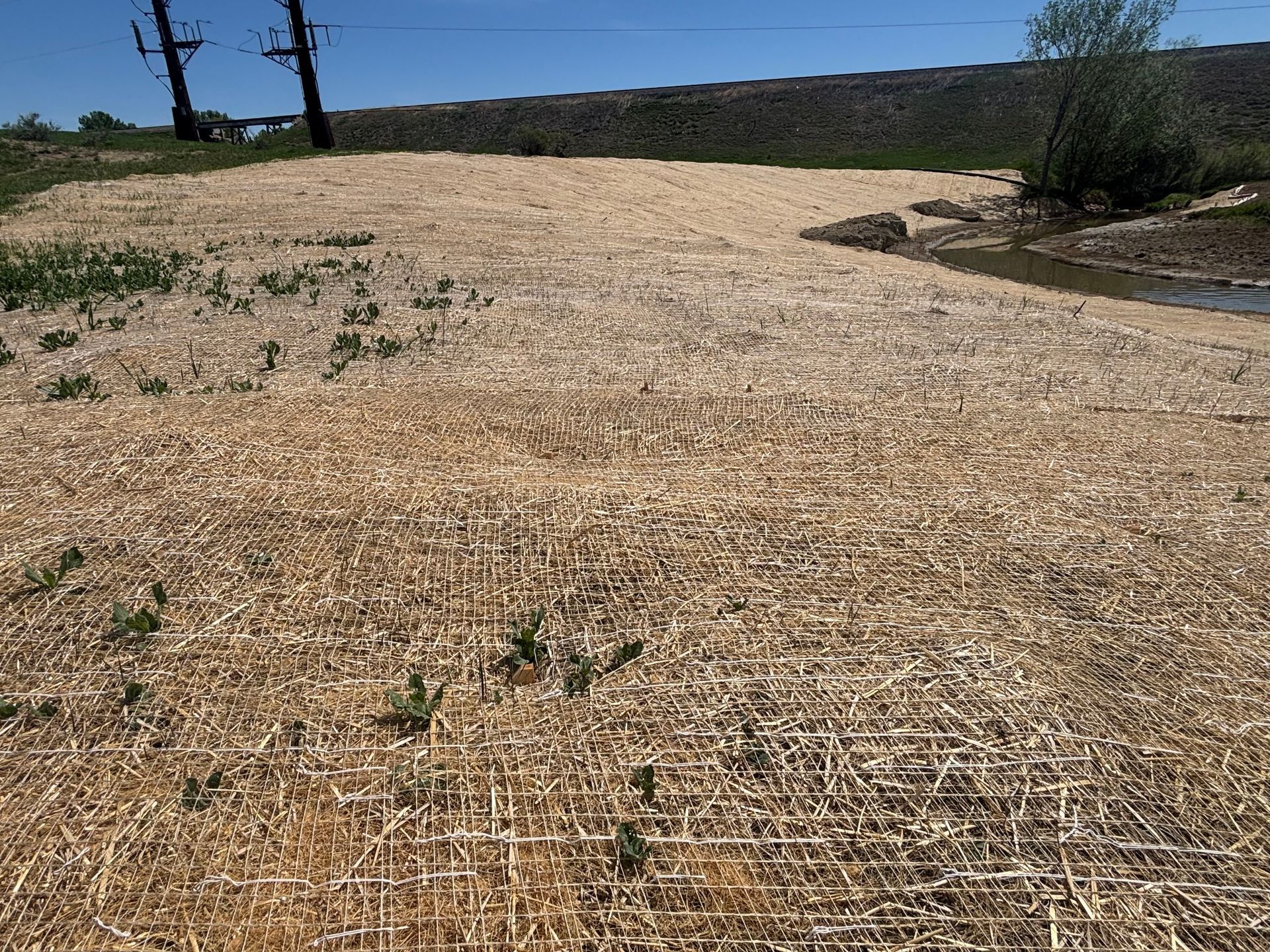
Foot traffic and point loading compact soil. That isn't controversial — it's the same mechanism that gives you hardpan in a heavily walked field. The top few inches lose pore space, infiltration rate drops, and the surface you just covered is now less able to absorb water than it was before the crew arrived.
The paradox writes itself: you install a product to stop runoff, and the installation itself reduces the soil's capacity to take in water. The blanket holds the surface in place, yes — but it's now holding a compacted,
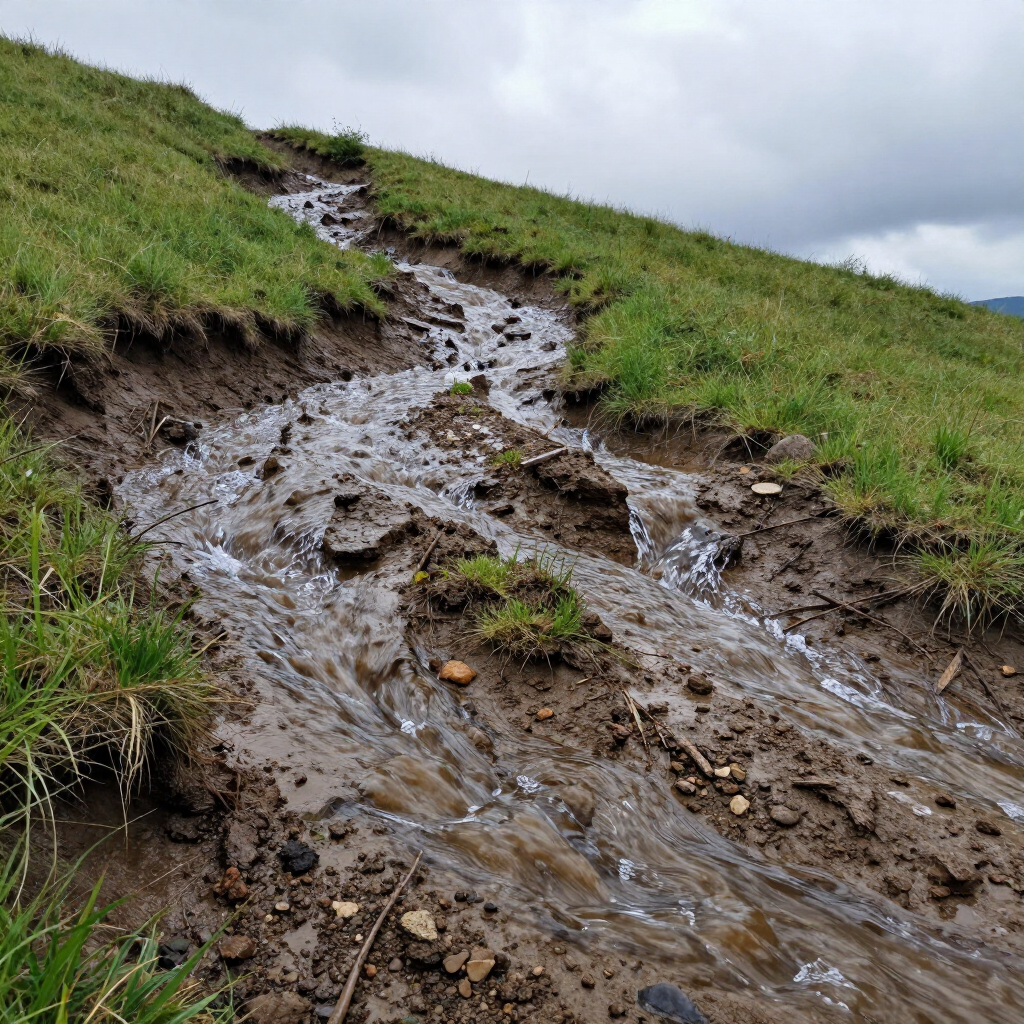
low-infiltration surface in place. Water that can't go down has to go somewhere, and it goes sideways and downslope, concentrating into the very flow paths the blanket was supposed to interrupt.
It's worth putting a number on what's at stake. Hold the variables that usually get blamed for failure constant — soil type, rainfall intensity, slope grade, antecedent moisture — and look only at the condition of
the surface. Roughening the upper three inches of soil would reasonably be expected to increase effective infiltration and short-term surface retention by roughly 20–30%, with higher values possible where the
roughening creates continuous depressional storage across the slope.
Now read that backward. If a rough, open surface buys you 20–30% more infiltration, then compacting that same surface during installation forfeits it. The paradox isn't just qualitative — it's a measurable swing in the wrong direction, and it lands precisely on the variable that determines whether water goes down or runs off.
What the measurements show
This isn't theoretical. Field and rainfall-simulator studies have put hard numbers on it.
Researchers at the University of Florida measured infiltration on sandy soils across a range of compaction levels using double-ring infiltrometers. On natural forested ground, uncompacted infiltration rates ran on the order of 380 to 630 mm/hr. Once those same soils were compacted by construction-style traffic, rates fell to roughly 8 to 175 mm/hr — in the worst cases, a drop of more than 95%. Their conclusion is the one worth sitting with: a compacted but otherwise "pervious" soil can behave hydrologically like an impervious surface. You haven't paved the slope, but as far as the rain is concerned, you nearly have.
How easily does that happen? The same body of work found that driving over one spot just nine times with an ordinary pickup can compact sandy soil to a degree comparable to a dump truck or backhoe. A crew installing a blanket crosses most of the slope far more than nine times.
On the product side, Auburn University's Erosion and Sediment Control Test Facility tests erosion control treatments head-to-head under a calibrated rainfall simulator, following the ASTM D6459 standard, on a 3:1
slope at rainfall intensities up to 6 inches per hour. Across bare soil, straw, hydraulic mulches, and erosion control blankets, infiltration was consistently higher on the mulched slopes. A cover that's applied to the
surface, rather than installed by pressing and pinning it, lets more water in — which is exactly what you'd predict once you account for the compaction the installation itself imposes.
Why this hides so well
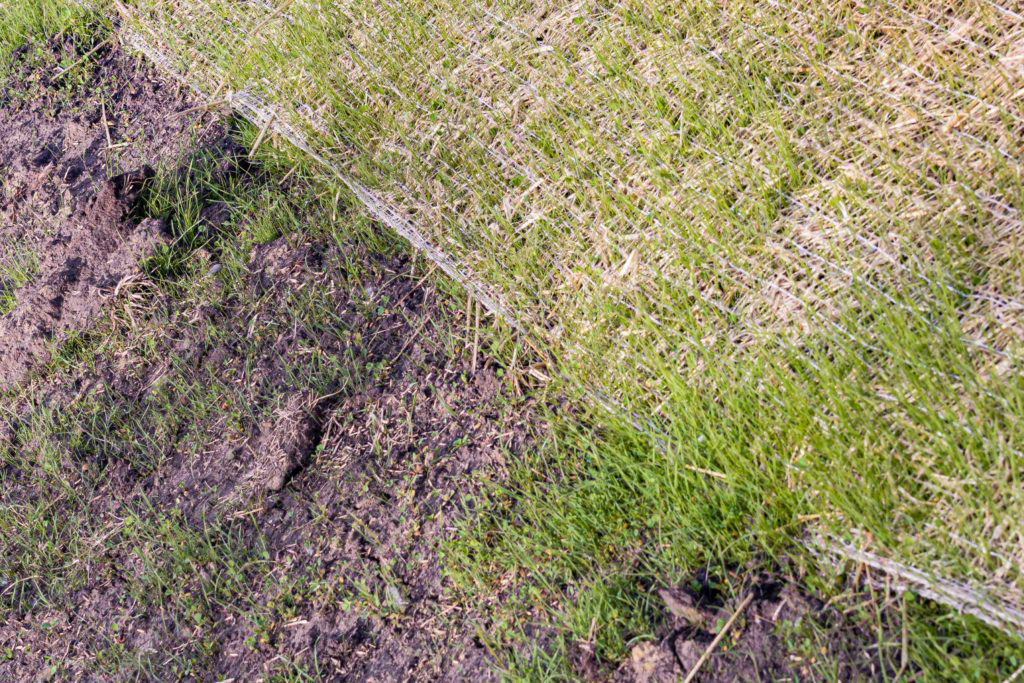
Compaction is invisible. The slope looks protected. The blanket is down, the staples are in, the photo for the
file looks great. The damage is two inches below the surface and doesn't announce itself until the first real
rain event — at which point the failure gets blamed on rainfall intensity, slope angle, or seed mix, almost
never on the installation method itself.
That's why this paradox persists. The cause and the symptom are separated by weeks and by a few inches of
soil, so the connection rarely gets made.
The alternative isn't a better blanket — it's no blanket
The way out of the paradox is to stop requiring a crew to walk and pin the entire surface. Engineered Wood
Strand mulch is applied to the slope rather than installed on it — distributed across the surface without the
systematic foot traffic and point loading that compaction depends on. The protective layer goes down
without the crew having to compress every square foot to make it work.
The result is a covered surface that kept its pore structure — one that still infiltrates, still lets seed emerge,
and still does the job the blanket was nominally there to do. You're protecting the soil instead of trading its
structure for the appearance of protection.
For readers who want the deeper mechanism — the field and rainfall-simulator data behind infiltration loss
and structure degradation — see our companion Soil Compaction Science Brief.
The takeaway for spec writers and contractors
When you evaluate an erosion control method, don't just ask whether it stays in place. Ask what it costs the
soil to put it in place. A method that protects the surface by degrading it has only moved the failure
downstream — and made it harder to diagnose when it shows up.
The best slope protection is the kind that leaves the soil better able to do its own job. By that standard, the
question isn't which blanket to spec. It's whether a blanket is the right tool at all.