Water Conservation Toolbox Final: "Do No Harm"
admin • July 17, 2026

The first three posts in this series covered what to specify: native species, infiltration-friendly soil, and durable ground cover. Part 4 covers what to be careful about specifying, because some of the erosion control and mulch materials most commonly written into restoration and revegetation specs work directly against the outcomes those specs are trying to achieve. Before a project can conserve water or restore habitat, it has to not actively undermine that goal — hence "do no harm."


Agricultural Straw: Not as Weed-Free as the Label Suggests

Most spec writers are already aware that straw can carry weed seed, which is why "certified weed-free" language shows up in almost every erosion control spec that calls for straw mulch. But it's worth being precise about what that certification actually guarantees, because it's narrower than the name implies.

Weed-free certification programs — run at the state level, generally following North American Invasive Species Management Association (NAISMA) standards — certify a field as free of a specific, defined list of noxious weeds. Certification is based on a visual field inspection conducted shortly before harvest, not a laboratory test of the baled product itself. That means certified straw is a statement about which noxious weeds were not observed in the source field, not a guarantee that the straw contains zero weed seed of any kind.

More fundamentally, agricultural straw is, by definition, the residual stalk material from a cereal grain crop — wheat, oat, barley, rice. Even a straw bale that passes noxious-weed certification with a clean inspection still consists of non-native crop species, because that's what the material is. On a project whose entire purpose is establishing native plant communities, introducing volumes of non-native grain species as mulch works against the stated restoration goal by definition, independent of whatever else might be riding along with it.

What Else Rides Along: Herbicide and Pesticide Residue

The weed-seed question gets most of the attention, but a separate and arguably more consequential issue is agricultural chemical residue — specifically a class of persistent broadleaf herbicides (picloram, clopyralid, aminopyralid, and related pyridine-group compounds) commonly applied to pasture and small-grain fields to control broadleaf weeds like Canada thistle.

These particular herbicides are used precisely because they're persistent, and that persistence is the problem for anyone using the straw downstream. Research on herbicide residue in agricultural byproducts has found these compounds remain chemically active through composting — most herbicides break down during composting, but this class specifically does not — with documented half-lives in soil of one to two years and, in some field cases, activity reported for several years after application. Sensitive broadleaf plant species can be affected at concentrations as low as 1 part per billion. Because these herbicides are selective for broadleaf weeds and largely spare grasses, straw treated with them can carry residue capable of suppressing the broadleaf forbs and pollinator-supporting species that most native restoration seed mixes are specifically trying to establish — the residue works directly against the native and pollinator-habitat objectives the mulch was specified to support.

The Installation Problem: Compaction and Emissions

Loose agricultural straw is typically blown or spread onto a site and then crimped — mechanically punched into the soil surface using a tractor-drawn crimping implement — to hold it in place against wind. That installation method has two costs worth weighing against Part 2 of this series: tractor and crimper traffic across a freshly graded, already-vulnerable soil surface adds a mechanical compaction load at exactly the moment infiltration capacity is most fragile, and running heavy equipment across the site consumes fossil fuel and generates emissions as a direct cost of installing the mulch itself.

Straw Isn't Just a Mulch — It Shows Up Throughout Erosion Control

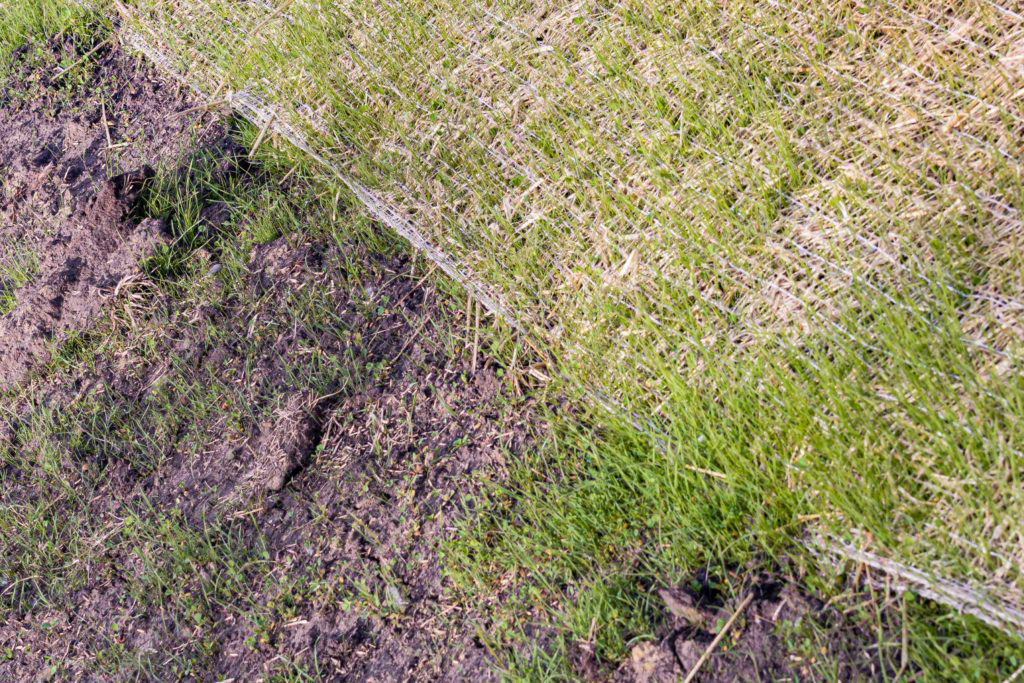
The same agricultural straw shows up well beyond loose mulch application: straw bale check dams, straw wattles, and — significantly — as the fiber filler inside a large share of rolled erosion control blankets (RECBs) on the market. Anyone specifying "natural fiber" erosion control products should confirm what fiber is actually inside the blanket, since a substantial portion of straw-filled RECBs carry the same weed-seed and herbicide-residue considerations described above, just packaged inside a manufactured blanket rather than applied loose.

The Netting Problem

Straw filler is only half of the typical rolled erosion control blanket. Most RECBs on the market hold that fiber fill in place using a plastic netting — usually polypropylene — and that netting carries its own, separately documented environmental cost.

Wildlife entanglement in erosion control netting is a well-documented problem in the wildlife biology literature, concentrated heavily in snakes, which get caught trying to pass through small mesh apertures and can't back out because their scales catch against the netting. One literature review of reptile entanglement cases found 175 documented entangled reptiles, 89 percent of them snakes, and 44 percent of all documented snake entanglements specifically involved erosion control products. State wildlife agency reporting has documented the same netting still intact and persisting on the landscape more than seven years after installation in some cases — well past the establishment period the erosion control was meant to serve.

Photodegradation doesn't solve the problem, and in practice often doesn't even reliably occur — netting on the underside of an installed blanket, shaded from UV exposure once vegetation grows up through it, can persist essentially indefinitely. When it does break down, it doesn't disappear; it becomes microplastic. USGS monitoring has found this is not a marginal concern: Great Lakes surface water has been measured at an average of 112,000 plastic particles per square mile, with plastic particles detected in 12 percent of sampled freshwater fish.

Natural-Fiber Netting Isn't a Complete Fix Either

Some spec writers have already responded to the netting problem by specifying natural fiber netting — typically jute — in place of polypropylene, which does address the entanglement and microplastic issues. But it comes with two caveats worth flagging in a spec review: jute netting carries a substantial cost premium over plastic netting, and a jute-netted blanket still commonly uses agricultural straw as its fiber filler, meaning the weed-seed and herbicide-residue issues described above aren't resolved just because the netting was upgraded. A more recent development addresses that second gap directly — RECBs using wood fiber (typically excelsior) rather than straw as the filler — but that combination (natural netting plus wood fiber filler) adds further cost on top of an already premium-priced product.

The Bottom Line for Decision Makers

None of these materials are used because they're the best environmental performers — they're used because they're the incumbent, familiar option, often at a lower up-front unit cost than the alternatives. But weighed against what a restoration or erosion control spec is actually trying to accomplish, agricultural straw introduces non-native crop species and, in a meaningful share of cases, persistent herbicide residue that directly opposes native plant and pollinator-habitat objectives; its installation method adds soil compaction and emissions; and the plastic netting used in most RECBs creates a documented, multi-year wildlife entanglement hazard that ultimately resolves into microplastic contamination of soil and water. Natural-fiber netting and wood-fiber filler both address pieces of this problem individually, each at added cost. The specification that does no harm on every count is one built from a single, 100 percent natural material — no agricultural chemical residue, no non-native seed source, no plastic netting — from the start.

This concludes the Water Conservation Toolbox series: turf conversion, infiltration, evaporation and ground cover, and now the materials question that underlies all three.
By admin July 14, 2026
Evaporation, Ground Cover and the Interstitial Space Problem  Parts 1 and 2 of this series covered species selection and infiltration — getting water to fall or apply in the right place, and getting it into the ground rather than off the site. Part 3 addresses what happens to the water that does make it into the soil surface but never gets the chance to infiltrate or be used by a plant at all: evaporation. In native and low-water landscape design, the water lost to evaporation is concentrated in a specific, often under-specified location — the bare ground between plants. Why Interstitial Space Is the Overlooked Failure Point Native and low-water plantings are, by design, spaced more openly than turf. A buffalograss or blue grama planting, or a native forb and bunchgrass mix, doesn't form a continuous, gap-free canopy the way mowed turf does — and that's part of what makes it low-water in the first place. But it also means a larger proportion of the site is bare soil at any given point in the establishment period, particularly in year one and two before plants reach mature spread. That bare interstitial space is exactly where evaporation losses concentrate. Agronomic research on mulching and crop water use notes that evaporation from the soil surface is most significant precisely when a canopy has not yet closed and shading is incomplete — once a canopy closes and fully shades the soil, evaporation losses drop sharply and nearly all water loss shifts to plant transpiration, which is water the plant is actually using rather than losing. A native landscape's wider plant spacing means it spends a longer time in that pre-canopy-closure state than a bluegrass lawn ever does, which is exactly the reason the ground between plants needs to be treated as its own design element, not a gap to be ignored until the plants fill in. What the Research Says About Cover and Evaporation NRCS Conservation Practice Standard 484 (Mulching) sets a specific, testable benchmark for this problem: mulch materials should cover at least 90 percent of the soil surface to meaningfully reduce evaporation. That threshold matters because partial coverage leaves enough exposed soil for evaporation to continue at close to bare-soil rates in the uncovered fraction. Controlled studies on mulch depth and evaporation back up why coverage and depth both matter. One replicated study found that a mulch layer reduced surface evaporation to roughly 40 percent of the loss rate measured from bare soil, with all common mulch materials performing similarly once applied at an effective depth — the deciding factor was thickness and coverage, not material type. That same study found that doubling mulch depth from 5 to 10 centimeters maintained soil moisture roughly 10 percent higher through most of the test period, though increasing depth further, to 15 centimeters, produced no additional benefit — useful data for anyone trying to specify a cost-effective application rate rather than simply maximizing depth. A broader review of mulching research across irrigation science reached the same conclusion from a different angle: mulching's evaporation-reduction effect is most pronounced early in a planting's life, exactly the establishment window when a native seeding or plug planting has the least canopy coverage and the most exposed interstitial soil. The Shade Mechanism Evaporation is ultimately an energy-driven process — water loss scales with how much solar energy reaches and heats the soil surface. This is why shade, whether from mulch or from plant canopy, does double duty: it doesn't just reduce evaporation directly the way a physical barrier does, it also lowers the surface temperature that drives evaporation in the first place. Field research comparing surface temperatures across cover types found bare soil and mulch surfaces run dramatically hotter in direct sun than in shade — one urban surface-temperature study recorded shading reducing surface temperatures by an average of 20°C across the tree species studied, with some species producing reductions of nearly 40°C. The same research found bare soil showed one of the largest shade-driven temperature swings of any surface type tested, second only to mulch itself — meaning the interstitial gaps in a young native planting are also the hottest, highest-evaporation-demand parts of the site precisely when plant canopy isn't yet available to moderate them. Research on grass tussock spacing found the effect of ground cover on soil moisture can be dramatic: covered soil maintained volumetric moisture content up to twelve times higher than adjacent bare soil under the same conditions, an effect the researchers attributed specifically to the reduction in evaporative demand that cover and shading provide — separate from any water the plants themselves were using. The Practical Spec Question: How Long Does Cover Need to Last? This is where the interstitial space problem becomes a specification and material question rather than just a design principle. A newly planted native landscape doesn't reach full canopy closure in one season — establishment for native grass and forb species commonly runs two to three growing seasons before plant spread meaningfully closes the gaps between individuals. Whatever ground cover is specified for those interstitial spaces has to remain functional — intact, in place, still providing the coverage percentage and shade effect the research above depends on — for that entire window, not just through the first summer. A cover material that degrades, blows off, or compacts into a crust within a single season leaves the site back at bare-soil evaporation rates for the balance of the establishment period, undoing the benefit before the planting has had the chance to close the gap on its own. For spec writers, that argues for evaluating candidate mulch or cover materials specifically on multi-season durability and coverage retention — not just first-year appearance or cost per unit area — since the entire evaporation-reduction case above depends on the cover still being there when the second and third growing seasons arrive. The Bottom Line for Decision Makers Water lost to evaporation from bare interstitial soil is one of the largest, least visible water losses in a native or low-water landscape, concentrated specifically in the gaps between plants during the multi-year window before canopy closure. NRCS's 90-percent coverage benchmark and the research on mulch depth and shading both point to the same conclusion: coverage percentage, depth, and — critically — how long that coverage lasts relative to how long establishment actually takes are the variables that determine whether a landscape's water conservation benefits show up in year one or get lost to evaporation before the plants ever get the chance to deliver them. Next in this series: designing for stormwater capture and detention on retrofitted native landscapes.
By admin July 10, 2026
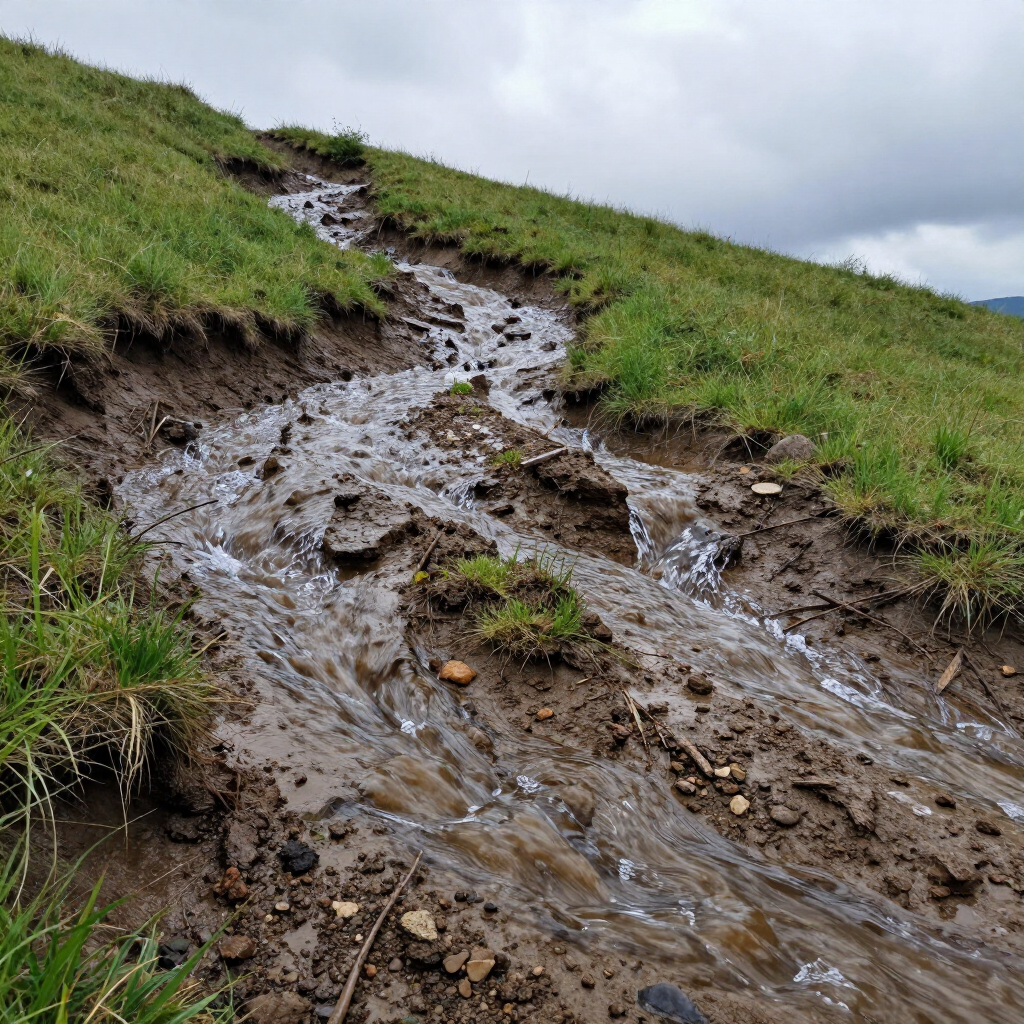
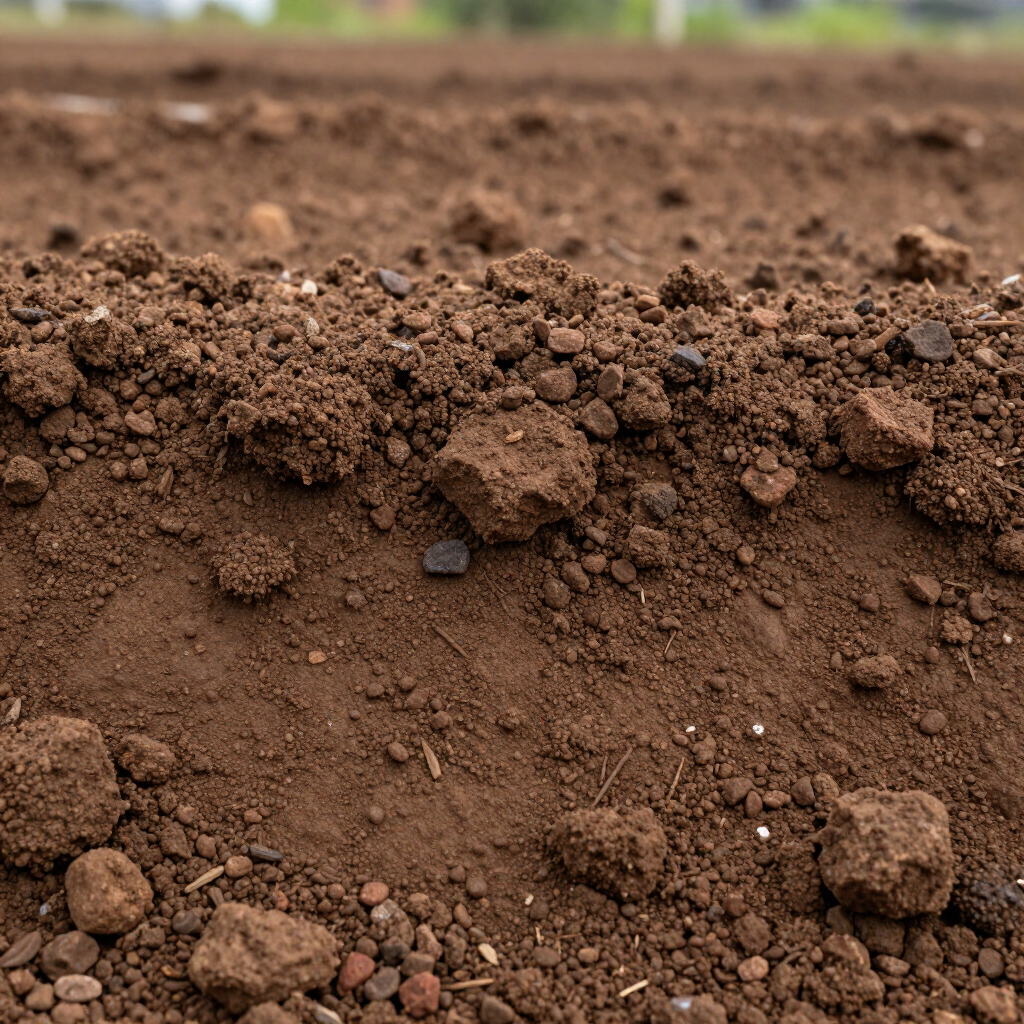
Why Infiltration is so important In the first post in this series, we looked at turf conversion — replacing high-water turfgrass with native, low-water species. But species selection only pays off if the water that falls or is applied on a site actually gets into the ground. A native seed mix planted into compacted, non-porous soil will underperform a conventional lawn on a well-structured site. Infiltration — not plant selection alone — is the variable that determines whether a landscape functions as a water conservation asset or simply looks like one. What Infiltration Actually Does The U.S. Geological Survey frames infiltration as the mechanism that connects surface water to the rest of the water cycle: water that infiltrates moves through the shallow soil layer, some of it is used by plant roots, and — depth and soil conditions permitting — some of it continues downward to recharge groundwater aquifers. Site design that maximizes infiltration is, functionally, aquifer recharge design. Site design that maximizes runoff is the opposite: water leaves the site as fast as possible, taking topsoil and pollutants with it and doing nothing for the water table underneath. For public works, stormwater, and land management programs, this reframes infiltration from an environmental nicety into an asset management question: every increment of infiltration capacity a site retains is stormwater infrastructure the municipality didn't have to build. The Compaction Problem Is Bigger Than Most Specs Assume Soil compaction is the single most controllable variable in this whole picture, and the data on how much it costs is stark. Published research on urban soil compaction found that construction activity — grading, equipment traffic, soil moving — reduced infiltration rates by 70 to 99 percent compared to undisturbed soil at the same sites, with maximum compaction typically occurring 8 to 12 inches below the surface, right in the zone most seed and root establishment depends on. Non-compacted natural forest and pasture soils in that same research averaged infiltration rates in the range of 9 to 25 inches per hour; compacted soils at comparable sites dropped as low as 0.3 to 7 inches per hour. That gap is almost entirely a construction-sequencing and specification issue, not a plant-selection issue. USDA-NRCS soil health guidance identifies the same mechanism from the agricultural side: compacted or impervious soil layers simply have less pore space, and long-term infiltration recovery depends on practices that rebuild organic matter and aggregation and minimize further disturbance. NRCS technical documentation on tillage transitions notes that once a compacted layer is broken and soil structure begins reconsolidating, meaningful infiltration recovery can still take two to seven years — which is a useful number to have in hand when a client or reviewer asks why decompaction and soil amendment need to be specified up front rather than addressed later. Root Systems Are an Infiltration Input, Not Just an Irrigation Output This is where the Part 1 turf conversion discussion and infiltration performance connect directly. A peer-reviewed meta-analysis of infiltration studies across conventional and alternative farming practices found that introducing perennial vegetation — grasses, agroforestry, or managed forestry — produced the largest measured increases in infiltration rate of any practice studied, an average of roughly 59 percent, with cover crops adding a further 35 percent on average. The mechanism is continuous living roots and undisturbed ground cover, which build soil aggregation and macropore networks that compacted, frequently-disturbed turf systems don't develop. Rooting depth itself is a large part of the story. University extension research on prairie root systems documents warm-season native grasses producing root systems 4 to 8 feet deep, concentrated in the top 12 inches but extending far below it. Kentucky bluegrass, by contrast, is typically documented in managed lawn conditions at 3 to 6 inches of root depth, with some sources citing up to 18 inches under ideal, infrequent-irrigation management — still an order of magnitude shallower than native prairie species at full establishment. Deeper, denser root architecture creates more continuous pore pathways for water to move down through the soil profile rather than sheeting off the surface. NRCS field data on residue and mulch cover adds a related, practical number: soil health management practices that combine reduced disturbance with mulch or residue retention showed up to a 30 percent increase in infiltration rate and moisture retention, and a review of multiple studies found mulch and cover practices reduced surface runoff by 4 to 50 percent depending on site conditions. A Necessary Caveat on Recharge It would be an oversimplification to say deep roots always mean more aquifer recharge, and the research doesn't support that as a blanket claim. Deep-rooted vegetation also increases evapotranspiration, and several studies — including USGS-adjacent groundwater research and a UC Riverside-led study on shrub encroachment — found that in some landscapes, deep-rooted woody or perennial species intercept and use more of the infiltrated water before it ever reaches the water table, particularly on flat terrain with high water demand from the vegetation itself. Recharge outcomes depend on the balance between infiltration capacity, rooting depth, plant water demand, and local topography — which is exactly why generic landscape specs and one-size-fits-all root-depth requirements tend to underperform site-specific hydrology work. The takeaway for spec writers isn't "deeper roots always recharge more groundwater." It's that infiltration capacity is the precondition for recharge to be possible at all — and that getting the soil right is the part of the system decision-makers actually control, regardless of how a given planting plan nets out on evapotranspiration. What This Means for Specifications For anyone writing or reviewing a landscape, erosion control, or stormwater management spec, the infiltration research points to a short list of controllable, testable requirements: Decompaction as a line item, not an afterthought. Given the 70–99 percent infiltration loss documented on compacted construction sites, post-construction decompaction (subsoiling, tilling, or equivalent) should be specified and verified before planting, not assumed to self-correct. Organic matter and soil amendment targets. Since aggregation and organic matter content are the mechanisms behind long-term infiltration recovery, specs should include measurable soil amendment requirements rather than a generic "amend as needed" clause. Root-appropriate species selection matched to site hydrology , not just water-use tables — a deep-rooted species is only an infiltration asset if the site's soil structure and drainage actually allow water to reach those roots. Protective ground cover during the establishment window. Every mechanism above — aggregation, macropore development, root establishment — takes time, and bare soil during that window is exposed to the same crusting and erosion risk that undermines infiltration gains before they can develop. A soil-contact mulch cover that holds moisture and limits surface disturbance during establishment is what protects the infiltration investment until root systems can take over that job themselves. The Bottom Line for Decision Makers Plant selection gets the attention in most water conservation conversations, but infiltration capacity is the variable that determines whether that plant selection actually delivers a water conservation outcome. Soil compaction alone can erase 70 to 99 percent of a site's infiltration potential regardless of what's planted in it, and rebuilding that capacity through organic matter and root development is a multi-year process, not a one-time fix. Specifications that treat decompaction, soil amendment, and establishment-phase protection as core requirements — not afterthoughts to the planting plan — are the specifications most likely to produce a landscape that actually functions as water conservation infrastructure.
By admin July 10, 2026
Turf Conversion in Colorado Cities Has Many Benefits Kentucky bluegrass has been the default landscape specification for Colorado municipalities for decades, but it was never suited to this climate. It's a cool-season, water-intensive species bred for wetter regions — not the semi-arid High Plains and Front Range. As drought pressure, population growth, and tightening water budgets push municipal water providers, parks departments, and DOT right-of-way programs to reconsider standard landscape specs, the case for converting turf to native, water-wise plantings is increasingly a budget and policy question, not just an aesthetic one. The Water Math That Matters to Utilities Outdoor irrigation is the largest driver of peak summer demand for most Colorado water providers, and turf is the largest single consumer of that irrigation. For utilities managing treatment capacity, storage, and peak-day infrastructure costs, the native alternatives are a meaningful demand-management lever: Buffalograss (Bouteloua dactyloides), a warm-season native forming a dense, mowable turf, uses roughly a third of the water Kentucky bluegrass requires once established — making it a viable turf replacement for parks, medians, and low-traffic public turf areas. Blue grama and sideoats grama deliver similar water savings and are well suited to larger, lower-maintenance rights-of-way, detention areas, and open space parcels. Fine fescues offer a cool-season option for sites where a closer-to-traditional turf appearance is a design requirement, at meaningfully reduced water input. Worth noting for anyone building a public-facing case: a 2024 CWCB analysis found that converting all non-functional turf statewide would save only a small fraction of Colorado's total water use, since agriculture dominates statewide demand. The value case for municipal turf conversion isn't a statewide water crisis narrative — it's peak-demand management, avoided infrastructure costs, and rate stability at the utility and district level, where outdoor water use is concentrated. Policy and Funding Are Already Built for This This isn't a discretionary sustainability initiative anymore — it's increasingly baked into Colorado code and grant structures that spec writers and program managers should already be tracking: HB22-1151 (2022) created the state's Turf Replacement Grant Program, providing matching funds to municipalities, water providers, and eligible nonprofits to run local rebate and conversion programs. Individual homeowners and HOAs aren't eligible to apply directly — this is a program built around institutional applicants. Aurora , Castle Rock , Colorado Springs Utilities , Denver Water , and others already have submitted applications and active local programs; several — Castle Rock among them — have gone further and written non-essential turf prohibitions directly into new-development landscape ordinances (Castle Rock's ColoradoScape requirement is a useful reference spec). The institutional logic driving these ordinances: retrofitting existing turf costs several thousand dollars per site, while writing native-species requirements into new-development landscape ordinances prevents that cost from ever being incurred. For anyone drafting or revising municipal landscape code, that's the stronger long-run lever. Performance Case Beyond Water Savings For engineers and program managers evaluating turf conversion against maintenance and lifecycle budgets, the secondary benefits are where the numbers add up over time: Lower input requirements. Native grasses adapted to regional soils require substantially less fertilizer and pesticide input than turf bred for high-maintenance management, reducing chemical procurement and application labor on public land. Reduced mowing frequency and equipment wear , a direct line item for parks and right-of-way maintenance budgets. Improved soil infiltration and structure from deeper native root systems, which has knock-on value for stormwater management on public sites versus the shallow, compacted root mats typical of conventional turf. Habitat and pollinator function , increasingly a factor in grant scoring and public communications for municipalities pursuing sustainability certifications or state recognition. Where Public Projects Actually Fail: Establishment The tradeoff — and the part that should shape any spec or RFP — is that native seedings establish far more slowly than sod, and the first one to two growing seasons determine whether a public conversion project succeeds or becomes a visible, budget-draining failure that undermines the next round of funding requests. Bare, disturbed soil during that window is exposed to erosion, crusting, and weed competition, and inconsistent seed-zone moisture is the leading cause of native seeding failure on public sites. This is the point in a spec where erosion control and mulch cover selection stops being a line item and starts determining project outcome. A protective, soil-contact cover during establishment moderates soil temperature, extends moisture retention between irrigation cycles, and protects seed and emerging seedlings from wind and water erosion until root systems are developed enough to hold the site independently. For spec writers, this is the phase worth over-engineering relative to the rest of the project — a successful establishment period is what turns a turf conversion line item into a completed, defensible capital project. The Bottom Line for Decision Makers Turf conversion in Colorado isn't being sold on a statewide water-crisis narrative — the honest data doesn't support that framing. The case that holds up is narrower and more concrete: measurable peak-demand reduction, avoided retrofit and infrastructure costs, lower long-term maintenance spend, and a state grant and code framework already built to support institutional applicants. The variable most likely to determine whether a given project delivers on that case is how well the establishment phase — soil, seed, and cover — is specified and executed.
By Website Editor July 6, 2026
The way out of the paradox is to stop requiring a crew to walk and pin the entire surface. Engineered Wood Strand mulch is applied to the slope rather than installed on it — distributed across the surface without the systematic foot traffic and point loading that compaction depends on.
By Website Author June 10, 2026
Compacted soil